Why lasers work Part 3 of 3
How CO₂, Fiber, Diode and UV Lasers Actually Generate Light
By Brandon Cullum Last updated Aug 5, 2026
So I published the review. Diodes can't match CO₂ on wood. Showed my test results. Explained the physics.
And oh man, the comments.
"Just tune the wavelength to 10.6 microns."
"There's gotta be a setting."
"You obviously don't know how to use it."
Look. I get it. I wanted there to be a setting. I spent $600 on diode lasers trying to make them work. But wavelength isn't like speed or power. You can't just "adjust" it.
Wavelength is locked by physics. Not software.
This page is the receipt for that sentence. Every wavelength in this guide has been treated as a given: a CO₂ laser puts out 10,600 nm, a diode 450 nm, a fiber 1,064 nm. Each laser type stores energy in a different kind of jump, and the size of that jump is the wavelength. Change the wavelength and you have changed the gas, the crystal or the dopant.
If the marketing had been honest, "20W at 450nm" against "50W at 10,600nm", people could've googled "what wavelength cuts wood" before buying. But "watts" sounds simple. And simple sells.
If you have not read the earlier parts, start with what the four laser types do in a shop and why materials absorb some wavelengths and not others.
How each laser type makes its light
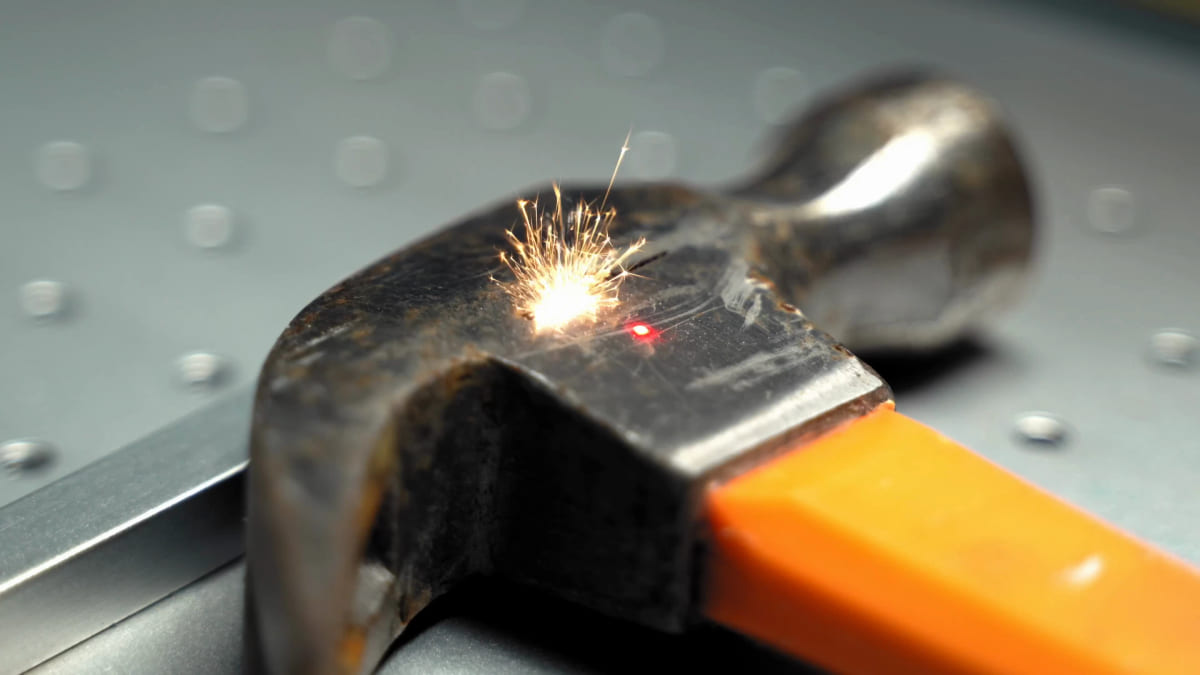
What all four have in common
Before the differences, the two things every laser on the list does identically. Explaining them once means the four sections below can be about what actually makes each machine different.
Population inversion. In any normal gas or crystal, nearly everything sits in its ground state and maybe one in a million is excited. A laser flips that: you pump energy in hard enough that more of the medium is excited than is not. It matters because a photon travelling through has two possible fates. Hit something in the ground state and it gets absorbed and disappears. Hit something excited and it triggers that thing to drop, surviving and creating a second identical photon alongside it. With mostly ground-state material, photons vanish faster than they multiply and the light dies. With mostly excited material, light grows exponentially. One photon becomes two, two become four, four become eight. That is stimulated emission, the SE in laser, and it is the entire difference between a light bulb and a beam.
The cavity. Every one of these has mirrors at both ends of the gain medium. One reflects everything, the other lets a fraction through. Photons bounce back and forth hundreds of times, triggering more emission on each pass. Anything travelling at an angle hits the wall and is lost, so only photons running perfectly parallel to the axis survive the round trip. The partial mirror lets those out, and that is your beam: billions of identical photons all going exactly the same direction. What differs between the four is the gain medium and the shape of the cavity around it, and nothing else.
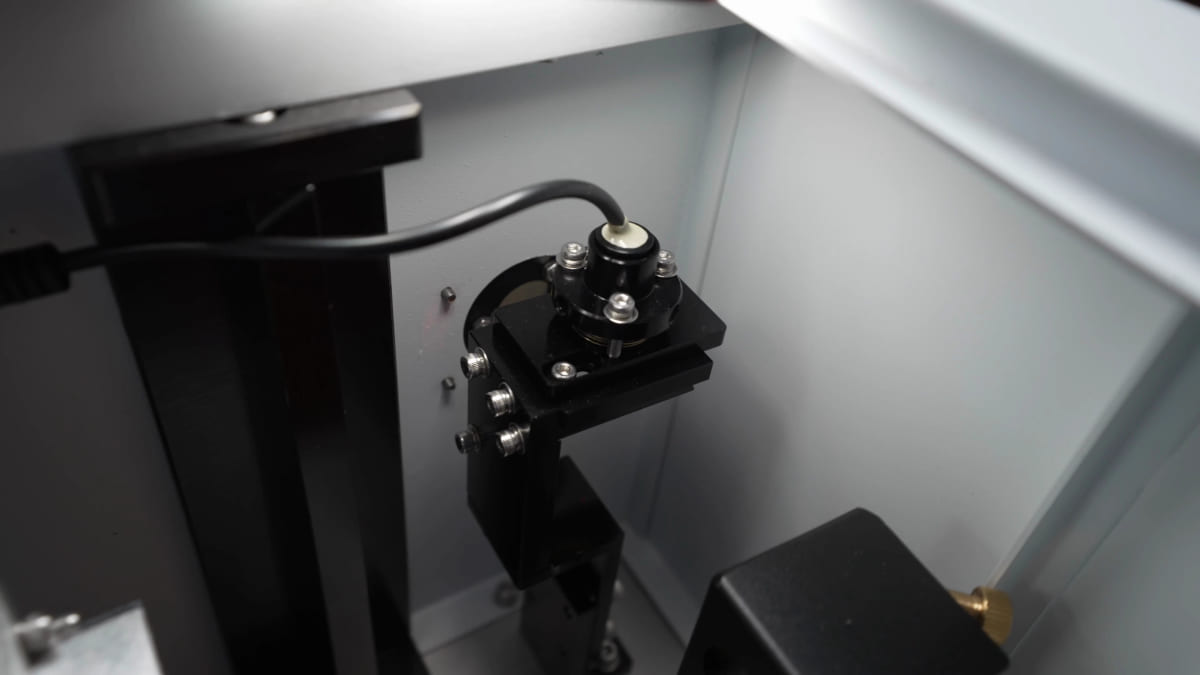
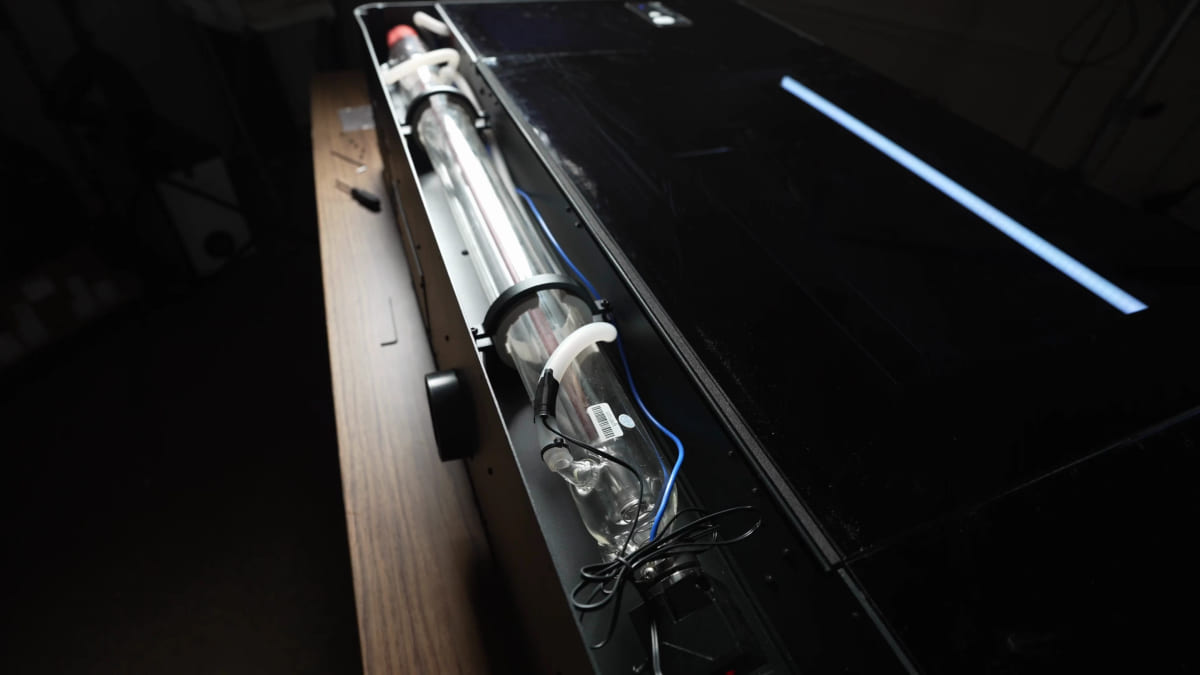
Pick a laser type to see what makes it different:
The interesting part: nitrogen does the work
A CO₂ tube is not filled with CO₂. It is filled with CO₂, nitrogen and helium, and the nitrogen is there because it is a better middleman than electrons are.
N₂ has a molecular weight of 28 against CO₂'s 44, so free electrons get it vibrating far more easily. Lighter cart, easier push. And N₂'s vibrational energy level happens to sit almost exactly on CO₂'s first excited state, so when an excited N₂ collides with a CO₂ molecule the vibration transfers cleanly, the way one tuning fork sets off another tuned to the same note.
Electrons to N₂ to CO₂ is measurably more efficient than electrons straight to CO₂. That indirect route is why the gas mix is what it is.
Getting there from a plug socket
The tube is sealed glass with a metal electrode at each end carrying 20,000+ volts. Switch it on and that voltage rips electrons off the gas molecules, creating a glowing plasma of free electrons moving fast enough to act like tiny billiard balls.
CO₂ can take that hit because it is lopsided. It is a linear molecule, O=C=O, but carbon has 6 protons and oxygen has 8, so oxygen pulls the shared electrons closer. The oxygen ends sit slightly negative and the carbon centre slightly positive, and a free electron has something to grab onto. Every molecule vibrates from heat anyway; this charge imbalance is what lets CO₂ vibrate much harder on demand.
The molecule can only sit in specific vibration states: gentle (v=0), vigorous (v=1), more vigorous still (v=2). The step between v=0 and v=1 is where a CO₂ laser stores its energy.
And then the drop
A molecule at v=1 cannot gradually wind down to v=0. It drops, the way you fall off a step. One moment it is vibrating vigorously, the next it is not.
Energy has to be conserved, so the difference has to go somewhere, and it leaves as a photon carrying exactly that much: 0.117 eV, which is 10.6 μm infrared. That number is not a design choice. It is the size of the gap.
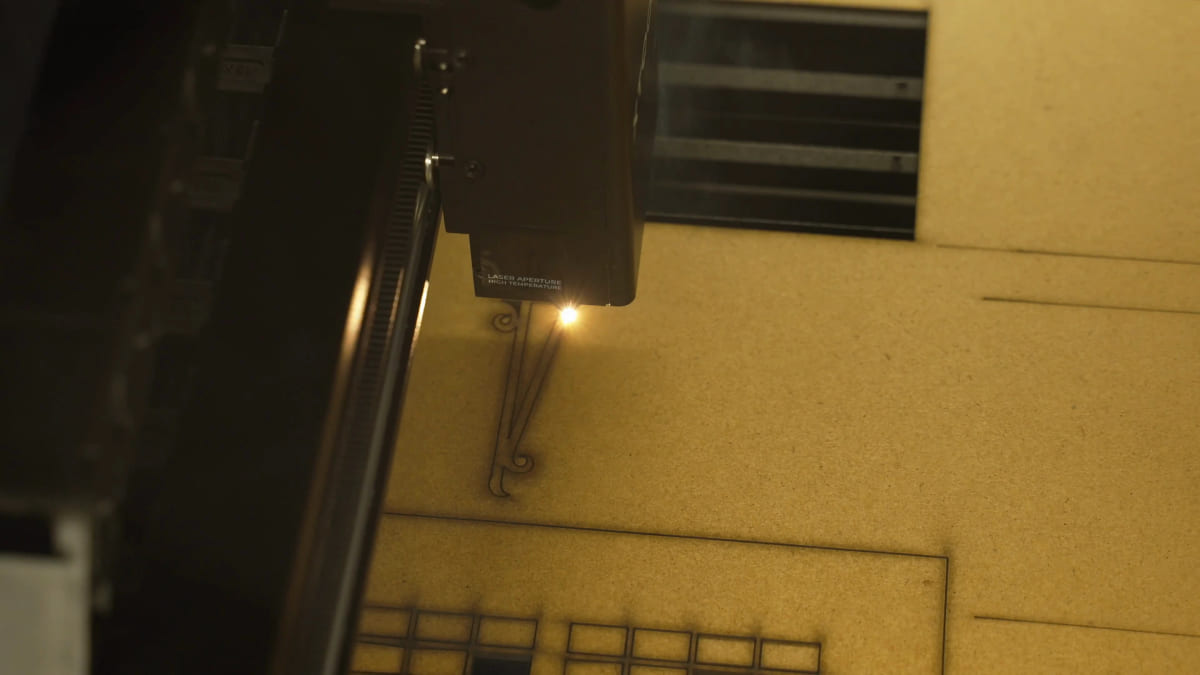
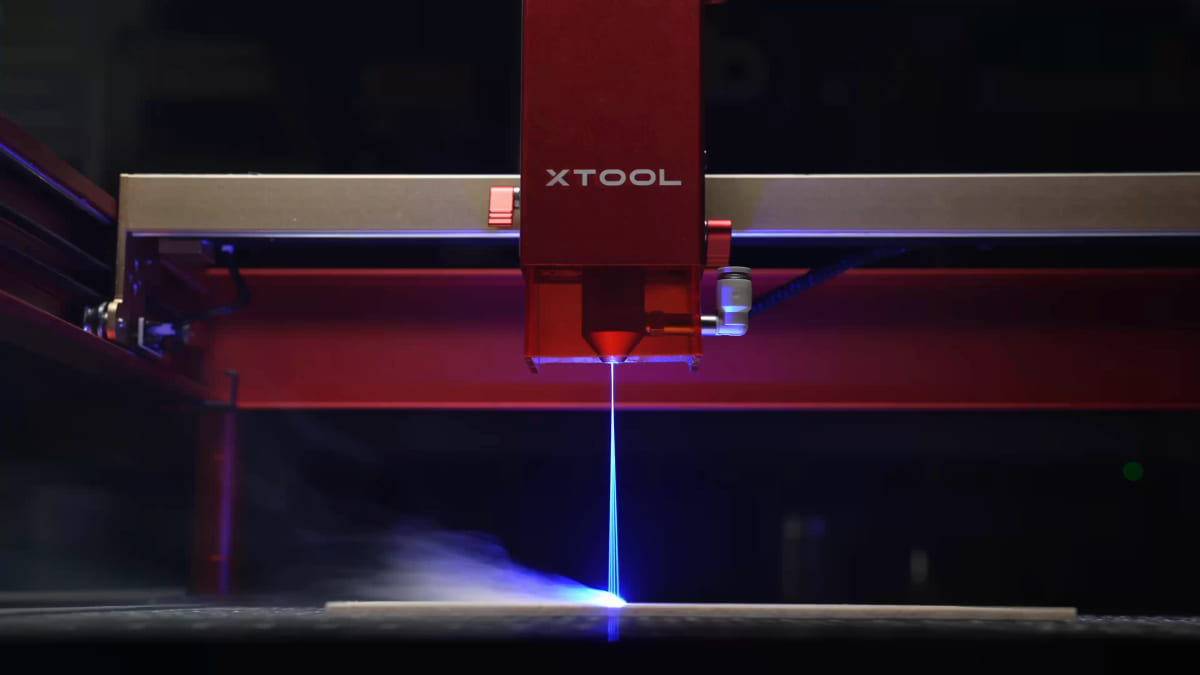
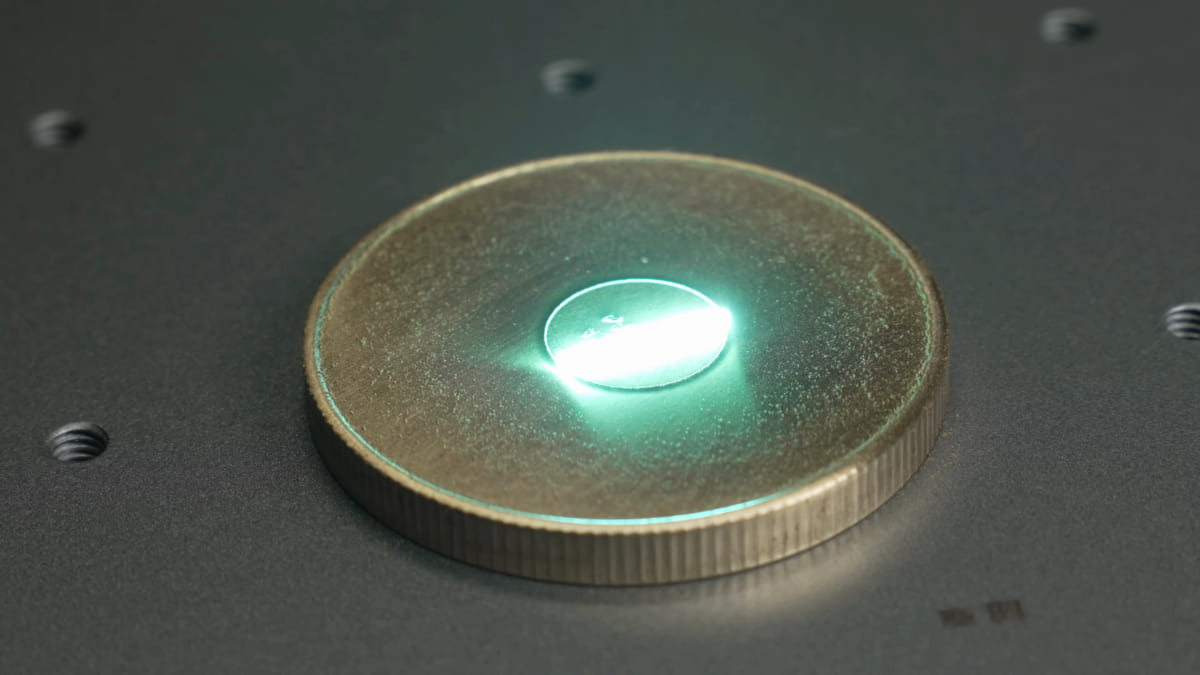

What comes out, and why
| Laser | Output | Per photon | Transition | Fixed by |
|---|---|---|---|---|
| CO₂ | 10.6 μm infrared | 0.117 eV | Vibrational, in a gas molecule (nuclear motion) | The gap between CO₂’s v=1 and v=0 vibration states |
| Diode | 450 nm blue | 2.75 eV | Electronic, across a semiconductor band gap | The band gap of gallium nitride |
| Fiber | 1,064 nm near-infrared | 1.17 eV | Electronic, in a rare-earth ion’s 4f orbitals | The 4f energy levels of ytterbium |
| UV | 355 nm ultraviolet | 3.5 eV | None of its own. A fiber laser, frequency-tripled | Arithmetic: three times the fiber frequency |
What to do with this
CO₂ stores energy in nuclear motion, which is why it matches organic materials so well. Same quantum mechanism on both sides of the cut.
Diodes store it in a semiconductor band gap. Cheap and compact, wrong wavelength for most materials.
Fiber stores it in rare-earth ions and can pulse in nanoseconds, which is what beats thermal diffusion in metal.
UV is a frequency-tripled fiber laser. High photon energy breaks bonds directly without bulk heating, at roughly a sixth of the efficiency and several times the price.
But why does an electron have to drop rather than ease down? Electrons and molecules cannot gradually lose energy, they have to suddenly jump from one state to another. What stops them releasing it slowly, like a ball rolling down a hill? And for that matter, where does the octet rule come from? Why 8 electrons? Who decided these numbers?
Why energy comes in jumps at all
This is the last why, and it is the one where even physicists eventually say the math works and nobody knows why reality is like this.
Look, you don't need this level
Seriously. You already have everything you need to understand why your CO₂ cuts wood and your diode does not. Stop here and you know more than 99% of people who own lasers.
But if you are still reading, you are probably the kind of person who cannot let go of why energy states have to be discrete, why an electron cannot just ease its way down, or what is so special about the number 8.
All of those have the same answer: because electrons are waves, waves trapped in a confined space can only exist in specific patterns, and those patterns have specific energies. An electron can no more take an in-between energy than a guitar string can vibrate at a frequency between its allowed notes.
If that is enough, great, you are done. Fair warning if it is not: this gets into quantum mechanics. Not the math (I'm not a sadist), the concepts. It is weird and it will make you uncomfortable, which is normal, because it made the physicists who discovered it uncomfortable too.
Standing waves in a baking pan
Fill a baking pan with water and slosh it back and forth at random speeds. The water jiggles, waves bounce off the sides and interfere, and mostly nothing happens. Find exactly the right rhythm and you get huge standing waves instead: water piling at the edges, crashing down the middle, perfectly synchronised and building with every push.
That is a mode, a wave pattern that reinforces itself because it fits the space. The pan's size decides which frequencies work. Push slightly off that rhythm and the water fights you, because your push is sometimes in phase and adding energy and sometimes out of phase and taking it back. The energy sloshes between the water and your hand instead of accumulating. Hold onto that, because it is the entire explanation for why your diode struggles.
Guitar strings do the same thing. One half-wavelength fits the string and you get the fundamental; two fit and you get the second harmonic; three and you get the third. Anything in between cancels itself out, because only patterns that satisfy the fixed ends can survive. Organ pipes, same deal.
The pattern to hold onto
Confine a wave to a space with boundaries and only certain patterns can exist. Everything else destructively interferes and disappears. This is not an analogy for quantum mechanics. This is quantum mechanics.
Electrons are waves
Here is where it gets uncomfortable, because everything above applies to electrons. They are not little balls. They are waves.
The double-slit experiment settled it. Fire electrons through two narrow slits and, if they were particles, you would get two bright stripes. What you actually get is an interference pattern of alternating bright and dark bands, exactly like water waves passing through two gaps and overlapping.
And it holds even when you fire them one at a time, so slowly that only one electron is ever in the apparatus. The pattern still builds up dot by dot. Each electron interferes with itself, which means it is not going through one slit or the other, it is a wave going through both. Try to measure which slit and the pattern vanishes. They act like particles when you look and waves when you do not.
This is measurable, repeatable physics rather than philosophy. Electrons are waves, specifically waves of probability describing where one might be found if you measured it.
So if electrons are waves and atoms are the spaces confining them, atoms are tiny three-dimensional organ pipes. Only certain electron wave patterns can exist around a nucleus; the rest collapse immediately. Those stable patterns are what we call orbitals. Not orbits, because nothing is travelling in a circle.
Where discrete energy levels come from
Now the question answers itself. v=0, v=1, v=2 for molecular vibrations, discrete electron energy levels, specific photon wavelengths: they are all standing wave patterns, and only certain patterns fit.
A C-O bond is a spring with a nucleus on each end, except the spring is the electron cloud and the nuclei have wave properties too. v=0 is the fundamental, the lowest standing wave the bond supports. v=1 is the first harmonic, a more vigorous pattern where the nuclei swing further. v=0.5 cannot exist for the same reason a guitar string cannot vibrate between its fundamental and its first harmonic. The pattern does not fit, so it interferes with itself and dies.
Where the number 8 comes from
Solve the wave equation for electrons around a nucleus and only certain 3D patterns come out stable: spheres, dumbbells and more complicated shapes.
First shell: one spherical pattern (1s), 2 electrons.
Second shell, where chemistry happens: one spherical pattern (2s) and three dumbbell patterns (2p). Four patterns, 2 electrons each, 8 total.
Shell 2 supports exactly four stable wave patterns because that is what the geometry of fitting waves around a nucleus in 3D allows. Not three, not five. That is where the octet rule comes from, and it is geometry rather than a rule anyone wrote down.
Why only 2 per pattern? The Pauli exclusion principle: no two electrons can be in exactly the same state. But electrons have a property called spin, which is not literal spinning (they are waves) but is real and measurable, and it comes in two options. So each orbital takes one of each, and that is it. A third has to find a different pattern or go up a shell.
An atom with every pattern filled is stable, and one with gaps is reactive. Carbon has 6 electrons and needs 4 more to complete shell 2, so it shares with oxygen, hydrogen and other carbons, and that is how you get cellulose and lignin. Oxygen has 8 and needs 2, so it forms the C-O and O-H bonds your CO₂ laser is aimed at. Neon has 10, every pattern full, and bonds with nothing at all.
On resonance, energy is trapped. Off resonance, it comes back out.
Back to the baking pan, because this is the payoff. When a photon's frequency matches a transition between allowed states, each push adds energy to the standing wave. A 10.6 μm photon oscillates at exactly the v=0 to v=1 frequency of a C-O bond, so every photon that arrives pushes at the right rhythm. Energy accumulates in the vibrational mode, and with damping from collisions it cannot re-radiate fast enough, so it becomes heat. Temperature builds, bonds break, wood vaporises.
When the frequency does not match, the field still pushes on the electrons, just at the wrong rhythm. A 450 nm photon oscillates at 667 THz against the bond's 28 THz, roughly 24 times too fast. The electrons get shaken but out of phase with the driving field, and the oscillation they produce re-radiates most of the photon's energy straight back out. Elastic scattering. Light bouncing off. Maybe 1–5% couples into heat through random collisions, and the rest reflects or passes through.
Which is the whole guide, in one paragraph
Your 20 W diode struggles on light wood because most of its photons are off resonance for the C-O and C-H bonds that make up cellulose, so the energy sloshes back out. Only chromophores have wave patterns that match blue. Your 60 W CO₂ hits nearly every photon at the right frequency, energy gets trapped instead of re-radiated, and you are at ~90% absorption. That is the difference.
Why you cannot add power to fix a wavelength problem
One more quantum rule, and it is the one that makes the whole guide practical. Energy does not merely come in different amounts, it is quantized. Planck worked this out in 1900 trying to explain why hot objects glow: energy transfers in chunks, and the size of the chunk is locked to the frequency.
Which means you cannot save up small chunks to make a big one. Each photon interaction is independent. Either the chunk is big enough to cause the transition or it is not.
A C-C bond needs about 3.6 eV to break. A UV photon carries 3.5 eV and can do it directly. A CO₂ photon carries 0.117 eV. You could run a 60 W CO₂ against a 5 W UV and the UV would break C-C bonds while the CO₂ would not, and it has nothing to do with total power. Thirty CO₂ photons hitting the same bond do not pool their energy into one 3.5 eV event. They are thirty separate tiny interactions that each fail.
The transitions themselves are instantaneous for the same reason the levels are discrete: there is no in-between pattern to pass through, the way a guitar string cannot be halfway between two harmonics. When the drop happens the energy either becomes heat, spreading through the material as phonons, which is how cutting happens, or it becomes a photon, which is how lasers work.
What to do with this
You now have something most laser buyers do not, which is the actual reason a wavelength either works on a material or does not.
Next time you are looking at an unfamiliar material you do not have to guess. Look up what it is made of, find the energy gaps, match them to wavelengths. Five minutes instead of a stack of ruined test sheets.
And when someone shows you a spec sheet claiming a 30 W diode equals a 50 W CO₂, you know which questions to ask. What wavelength? What material? What bond energies?
Now when I review lasers, I ask about wavelength before I ask about power. When some company sends me a press release claiming their new 30W diode "rivals CO₂ performance," I order test materials. Because $600 taught me marketing doesn't understand quantum mechanics.
See which marks your laser can actually make Computed verdicts per machine, material and mark type, with the reason attached to every one.
That is as deep as the physics goes. After this you are asking why math describes reality, and nobody knows.
The useful direction from here is outward, not back to the top. Take an actual material and check it. The material guide has a row per material with the shop reality and the physics reason behind it. Five minutes, the way the takeaway above says.