Why lasers work Part 2 of 3
Laser Wavelength vs Material: Why 10.6μm Cuts Wood and 1064nm Doesn't
By Brandon Cullum Last updated Aug 5, 2026
A CO₂ laser at 10,600 nm cuts birch plywood in one pass. A fiber laser at 1,064 nm chars the surface and never gets through. A blue diode at 450 nm engraves walnut beautifully and struggles on pine. Same wattage bracket, wildly different results.
The reason is not power. It is that every material has a short list of photon energies it can actually absorb, and that list is set by what the material is made of and how those atoms are stuck together.
This part goes from what wood and metal are built from, through the bonds holding them together, to the moment a bond actually breaks. If you have not read the first part on photon energy vs quantity, start there.
What materials are actually made of
Wood and metal are not just different materials. They are built from completely different parts, with different formulas and different structures, which is why they need different lasers.
Organics: wood, acrylic, leather
At the molecular level, wood is cellulose: (C₆H₁₀O₅)ₙ. Those subscripts are the recipe, 6 carbon atoms, 10 hydrogen, 5 oxygen, repeated thousands of times in long chains. Carbon forms the backbone that basically all organic material is built on. Oxygen connects to that backbone, and those C-O connections are the thing to remember, because they are what a CO₂ laser is aimed at. Hydrogen hangs off the sides and fills the gaps.
Cut oak or acrylic or leather and you are working with variations on the same theme. The exact ratios differ (acrylic runs a different mix, leather adds nitrogen) but they are all carbon-oxygen chains with hydrogen attached.
Metals are a different blueprint entirely
After six years working with wood and then getting into metal, I assumed the chemistry would be roughly similar. It is not. Steel is mostly iron atoms in a crystal lattice. Aluminum is aluminum atoms in a different crystal arrangement. Copper is copper atoms in another. One type of atom (two in alloys) packed into an ordered grid, with no long chains and no complex molecules at all.
Glass and ceramics sit in between
Glass is silicon dioxide, SiO₂: one silicon atom bonded to two oxygens, repeated as a rigid 3D network extending in every direction. Picture a jungle gym where every joint is a silicon atom and every bar is an oxygen connection. It is molecular like wood, but with Si-O connections instead of C-O, and inorganic like metal, but built from two elements rather than one.
Why this matters
Three structures, three sets of absorption behaviour: C-O-H chains in organics, single-element grids in metals, Si-O networks in glass. Everything that follows hangs off which of those you are pointing a laser at.
But why does composition matter? Those atoms are not just sitting there, they are connected to each other, and the way they connect decides which wavelengths can do anything at all.
How atoms connect, and the gaps that creates
The core insight
Electrons only exist at specific energy levels, like steps rather than a ramp. A photon gets absorbed only if its energy matches the gap between two of those steps exactly. Anything else passes through or bounces off. How atoms share their electrons decides how big those gaps are, and therefore which wavelengths can touch the material.
If you want to know why electrons behave this way, that is the quantum section in part 3. For now it is enough that they do.
Covalent bonds: sharing between two specific atoms
Atoms want their outer electron shell full. Carbon has 4 electrons out there and wants 8. Oxygen has 6 and wants 8. So they make a deal and share, and both get to count the shared electrons as their own. In a C=O double bond they share four electrons, which leaves both atoms feeling full.
Those shared electrons sit in the space between the two nuclei, attracted to both. That is the glue, and that is a covalent bond: electrons locked between two specific atoms. Wood is made of them, C-O and O-H and C-C, chained together into molecules.
Metallic bonds: sharing between all of them at once
Metals do not pair up. Every iron atom gives up its outer electrons to a communal pool, leaving a lattice of positive ions with a sea of electrons flowing between them. Those electrons are not locked to any particular atom, they are free to move anywhere in the entire piece of metal.
That electron sea is where every metal property comes from. Free-flowing electrons conduct electricity, conduct heat, and make the surface shiny. It is also, as you will see in a moment, why a laser has such a hard time putting energy into metal and keeping it there.
Different bonds, different energy gaps
C-O bonds in cellulose
Electrons tightly locked between carbon and oxygen. The gap between the bonding state and the excited state is about 0.117 eV, which is an exact match for infrared at 10,600 nm. That is a CO₂ laser, and that is why it works on wood.
Chromophores in dark wood
Some molecules have alternating single and double bonds (conjugated systems) that spread electrons across several atoms instead of locking them between two. Lignin, tannins in walnut, natural dyes. Their gap is about 2.75 eV, which matches visible blue at 450 nm. That is a blue diode, and that is why dark wood, with more lignin, absorbs blue better than light wood does.
Metals
Free electrons have no discrete gaps at all. Their energy levels overlap into continuous bands, so the gap is effectively zero and any wavelength will be absorbed. Infrared, visible, UV, it does not matter. Metals are the one common material where wavelength is not the deciding factor.
This is where it clicked for me. The C-O bonds in birch have a 0.117 eV gap between vibrational states. CO₂ photons carry 0.117 eV, an exact fit. My diode photons carry 2.75 eV, which is more energy and the wrong amount of it.
It's like trying to use a $5 bill in a vending machine that only takes quarters. You're not broke - you've got money. But it's the wrong denomination. The machine literally can't accept it.
I spent 30 sheets of plywood trying to "tune the settings" - adjusting speed, power, focus, air assist. That's like waving the $5 bill at the vending machine slower. Or faster. Or from different angles.
Absorbing a photon is not the same as removing material. You know which wavelengths get taken up by which bonds. Now for what happens next, which turns out to be three genuinely different mechanisms.
How a laser actually breaks the material
There are two fundamentally different ways to remove material. With wood you break chemical bonds and create new substances, mostly CO₂ and water vapour and char. Carbon becomes carbon dioxide, and there is no going back. With metal you cause a phase change: the iron atoms stay iron atoms and just go solid to liquid to gas, the same way water stays H₂O when it boils. Same goal, completely different physics.
CO₂ on wood: vibrational resonance
This is the efficient one. Start with why light can push on a bond at all. In a C-O bond the two atoms share electrons, but oxygen pulls harder than carbon does, so the electron cloud sits closer to oxygen. That leaves oxygen slightly negative and carbon slightly positive. You have a dipole, a plus end and a minus end.
Light is an oscillating electric field. When that field hits a dipole it can push the negative end and pull the positive one, back and forth.
And the bond behaves like a spring. Push the atoms together and the electron cloud compresses and repels; pull them apart and the electrons pull them back. Like any spring it has a natural frequency, about 28 THz for a C=O bond, set by the atomic masses and the strength of the electron glue.
CO₂ laser photons oscillate at 28 THz. Exactly the C=O natural frequency. Push a swing at its natural rhythm and you can really get it going, and this is the same thing: each photon adds to the vibration instead of fighting it. Roughly 85% of each photon's energy transfers into the bond. After millions of photons over a few milliseconds the atoms are swinging so far apart that the electron cloud cannot reach both nuclei, the bond breaks, and the atoms leave as vapour.
Key point
This is the thermal path. You are building up vibrational energy until bonds break. It takes many photons, but each one contributes efficiently because of resonance. That is why a 60 W CO₂ cuts wood clean while a 60 W fiber just chars the surface.
Blue diode on wood: why colour matters so much
For years I thought blue diodes struggled on wood because they lacked energy or hit the wrong frequency. It turns out to be more interesting than that. From a blue laser's point of view, wood is two different materials: the part that absorbs blue light, and the part that does not.
Chromophoresare 10–50% of wood. Lignin, tannins, the compounds that make heartwood dark. Their conjugated systems spread electron clouds over multiple atoms, which gives them the right antenna for blue light. A 2.75 eV photon kicks an electron from a bonding orbital (π) to an excited one (π*). It sits there for nanoseconds and drops back, and in dense wood it does not release another photon, it releases heat. The electron's position shifts as it falls, yanking nuclei around, and those vibrations spread as heat until bonds break.
Plain C-O and C-H bonds are the other 50–90%. Basic cellulose, electrons locked in tight sigma orbitals with no conjugated systems. Blue light does interact with them, but at the wrong rhythm: the bond wants 28 THz and blue light oscillates at 667 THz. Sometimes the push is in phase and adds energy, sometimes it is out of phase and cancels. Net transfer is maybe 1–5%. And 2.75 eV is nowhere near the 5–6 eV needed to kick a σ electron to σ*, so there is no electronic transition available either. Most of that light reflects or passes straight through.
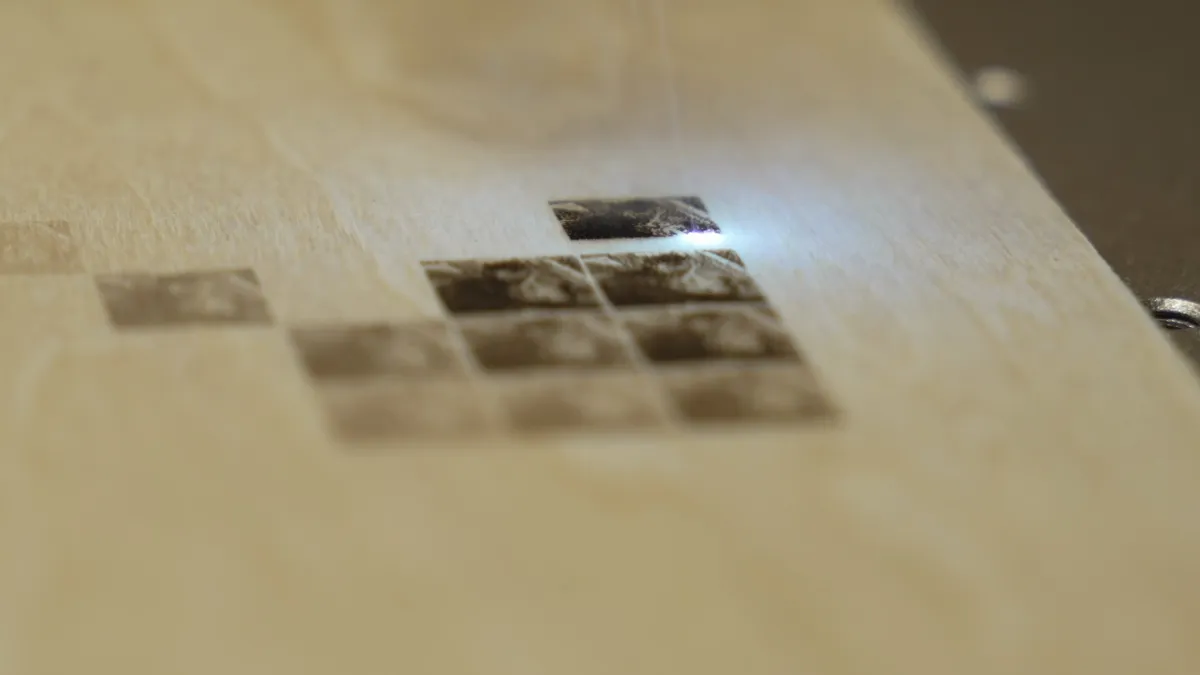
Light wood (pine, birch, maple) is only 10–30% chromophores, so 70–90% of the blue light lands on molecules that cannot use it. That is where the 15–20 passes come from. Dark wood (walnut, mahogany) runs 40–50%, so absorption is better and cutting is faster, though still short of CO₂ which works on 90%+ of the molecules. Stained and painted surfaces are 60–80%, because paint is full of chromophores. That is what makes it coloured. Which is why my Atomstack X20 absolutely rips through painted wood and struggles on raw pine.
So a blue diode slowly charring its way through light-coloured plywood is finding a chromophore in maybe 1 out of every 5–10 molecules. The rest of the wood is effectively invisible to it.
The confusion
People see 2.75 eV > 0.117 eV and assume the diode should do better. But it is not about energy per photon, it is about what percentage of the material can absorb that energy. CO₂ works on 90%+ of wood molecules. Blue diode works on 10–50% depending on chromophore content. That is the whole difference.
UV: breaking bonds one photon at a time
UV lasers skip vibration and resonance entirely. A 355 nm photon carries 3.5 eV, which is enough to promote a bonding electron straight into an antibonding orbital or ionise it outright. The electron stops doing its job, there is no glue left between the atoms, and they separate. No bulk heating, which is why it gets called cold ablation.
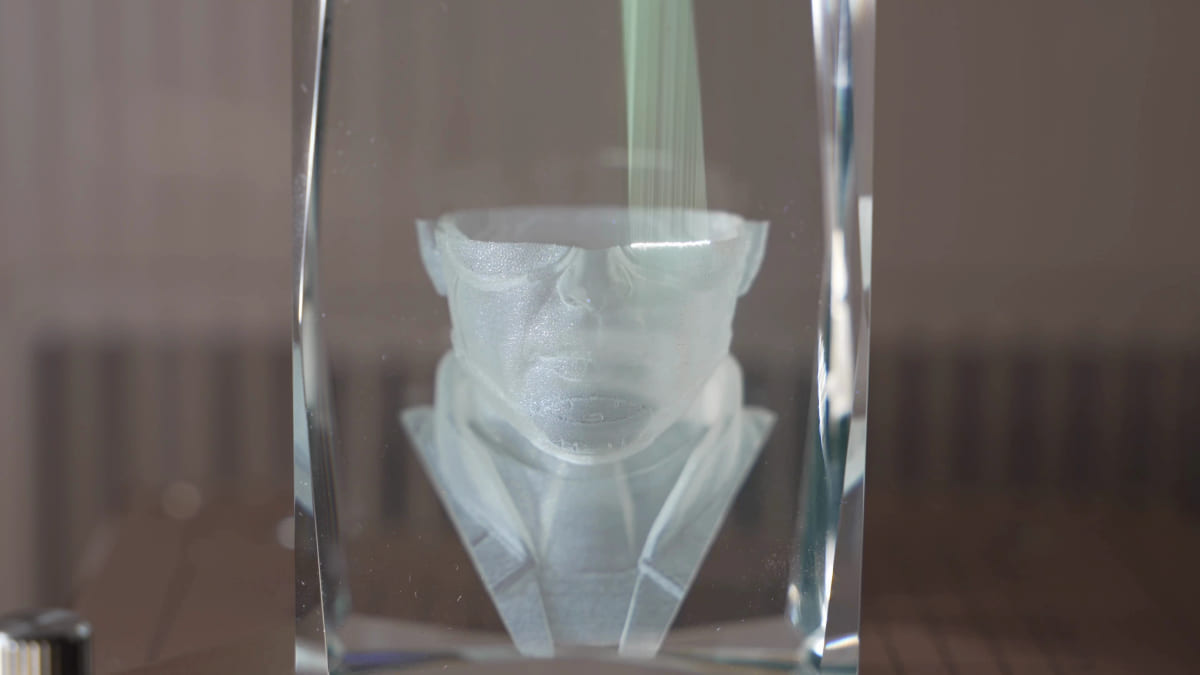
That is how UV marks glass, which is transparent to both CO₂ and fiber, and why it works on nearly everything. CO₂ and diode both accumulate energy over millions of photons. UV breaks the bond with one. The catch is cost ($3K–15K), low power (3–20 W) and fussy optics.
Fiber on metal: a race against heat leaving
With metal the question is never which wavelength resonates, because free electrons absorb everything. A photon arrives, a free electron takes it and speeds up, then collides with the lattice and hands over the energy as heat. The question is whether you can deliver that heat faster than it runs away.
In steel, thermal diffusion time is about 100 nanoseconds. By the time your next photon lands, the energy from the last one has already spread through the workpiece. CO₂ lasers are continuous or long-pulsed, so they lose that race, and their energy never piles up in one spot.
Fiber lasers pulse in 2 to 200 nanoseconds. They dump everything in less time than the heat needs to escape, and peak power during that pulse reaches kilowatts to megawatts even when average power is only 20–60 W. You heat a tiny spot faster than it can cool, the temperature spikes, the metal vaporises, and you get your mark.
For years I thought blue diodes could not mark metal because their photons lacked energy. Wrong, and backwards: a blue diode photon carries 2.75 eV against a fiber photon's 1.17 eV. The real reason is that diodes cannot pulse effectively. They run continuous, or pulse in milliseconds rather than nanoseconds, so thermal diffusion wins. Pulsing is the thing, not photon energy.
Continuous Wave (CW) - Fails on Metal
30W average power • Heat diffuses before temperature builds
Why it fails:Photons arrive continuously at modest power. Heat diffuses through metal in ~100ns. You're adding energy slower than it spreads away. Temperature never reaches vaporization threshold.
Pulsed Fiber Laser - Works on Metal
30W average • 5kW peak • 100ns pulses @ 50kHz
Why it works:Massive power spike (5kW) delivered in 100ns. Pulse ends before heat can diffuse. Local temperature spikes to vaporization. Between pulses, heat spreads (that's fine, damage already done).
Four mechanisms, then, and the machine you own only gets to use the ones its wavelength and pulse behaviour give it access to. That is why the comparison people reach for is the wrong one. Saying "20W diode cuts like 50W CO₂" is like saying "a 20lb hammer works like a 50lb saw because they both apply force to wood."
Sure. Technically true. Both remove material. But if you need clean cuts and you show up with a hammer, you're gonna have a bad time. Doesn't matter how hard you swing it.
Where any given combination lands
Every knob on your machine (speed, power, frequency, pulse width) is really two numbers: how long the beam sits on one spot, and how hard it hits while it is there. Plot those two and each mechanism above becomes a region you can either reach or you cannot. Pick a machine and a material and the map will show you which.
30 W MOPA fiber · 1064 nm · time axis: pulse width
What do you want to do?
What happens here
No mark
Surface never reaches a process temperature. Adding passes at this irradiance changes nothing except cycle time.
- Pulse width
- 500 ns
- Frequency
- 500 kHz
- Speed
- 7000 mm/s
- Power
- 74.51%
- Dose
- 0.0532 J/mm²
- Pulse width snapped to 500 ns. Your source only fires menu values.
- Speed held at 7000 mm/s, so pulses overlap more than planned.
Colour key
Band edges are soft. Dots are cards you ran, so believe the dot.
Drag anywhere on the map
Dimmed areas are out of reach for 30 W MOPA fiber.
No mark
Surface never reaches a process temperature. Adding passes at this irradiance changes nothing except cycle time.
LiteratureSee which marks your laser can actually make If you want the yes or no rather than the numbers, the verdict chips answer it per material and mark type, and say "unmodelled" instead of guessing.
Where do the photons come from? Everything so far treats the beam as a given. But a CO₂ tube, a diode chip, a doped fiber and a UV crystal stack make their light in four genuinely different ways, and that is what locks each one to its wavelength in the first place.