Laser capability
Can a fiber laser engrave wood?
Wood absorbs 1064nm light well enough to char, so the short answer is yes and it is not close. The useful answer is about what happens after that first dark line.
Yes, and dark marks come easily. The catch is that a fiber laser is still the wrong tool for most wood work, and the reason is spot size and working field rather than physics.
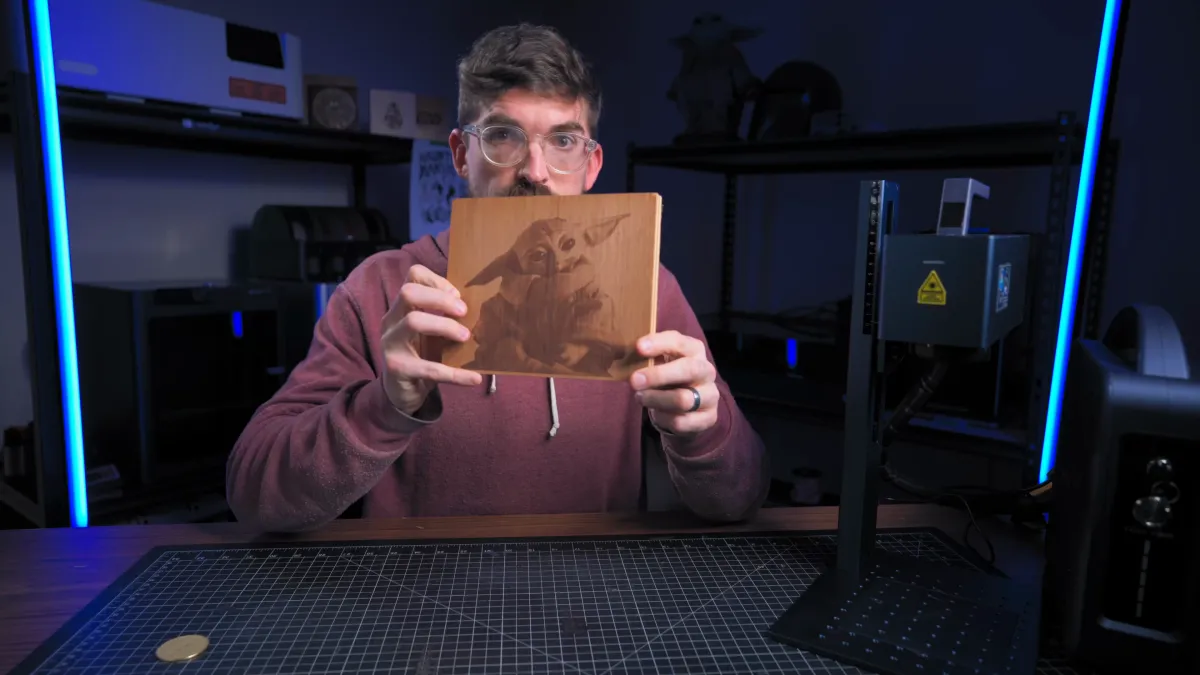
Yes, and the dark marks come fast
Wood does not need a special wavelength to react, because it is an organic material that breaks down thermally and heat is the whole mechanism. Push enough energy into the surface and the cellulose and lignin pyrolyze, leaving solid carbon behind, and carbon is black. Every laser family we cover gets a dark mark on wood for that reason, fiber at 1064nm included.
The wood rows below are labeled literature rather than measured, since our own test grids so far are on metals and the wood behavior comes from published material data. Treat the table as a direction to test in rather than a settings recipe.
So why does almost nobody engrave wood with a fiber laser?
Because a fiber laser is built around a very small spot. That tiny spot is exactly what makes fiber good at metal: it concentrates energy hard enough to move a melt pool or grow an oxide layer on steel. On wood, where the material reacts at a few hundred degrees, that concentration is more than you need. The beam removes and chars a narrow line very readily, and the width of the line it covers per pass is small.
Filling a large area means the machine has to lay down many more lines to cover the same square inch. A CO2 laser at 10.6um has a larger working spot and a working area measured in hundreds of millimeters, so it clears a photo-sized panel in a fraction of the passes. Most fiber galvo heads also work inside a field of roughly 100 to 200mm on a side, which is a coaster, not a cutting board. Nothing in the physics stops you. The clock and the field size are what stop you.
There is a second, quieter problem. Char is a surface residue, and the contrast you get from a fiber pass on wood is a carbon deposit sitting on top of the grain rather than a controlled depth of removal. It reads well on tight-grain hardwood and poorly on soft or resinous stock, where the early wood and late wood take heat at different rates and the mark goes blotchy. That is a wood problem, not a fiber problem, but the small fast spot makes the banding more obvious rather than less.
When a fiber laser on wood is the right call
There is a real case for it, and it is narrow. If a fiber laser is the machine you already own and the job is a small dark mark on a wooden item, such as a logo on a knife scale, a maker mark on a pen blank, or a serial number on a wooden case, running it on the fiber is faster than acquiring a second machine. The mark quality on hard, dense, tight-grain wood is genuinely good.
It also makes sense when the wood is a component of a mixed-material part. If you are already marking a steel insert and a wooden handle in the same fixture, one machine and one setup beats two.
What it does not make sense for is the thing most people mean when they say wood work: cutting sheet stock, engraving photos on plaques, or clearing large filled areas. Those are technically achievable and practically miserable, and the whole question is thickness. A thin veneer will separate, and quarter-inch hardwood chars the walls faster than the cut advances.
What we deliberately do not claim
Several rows in the table below come back as not yet modeled, and that is a gap in our data rather than a statement about what is possible. Grays, whites, and colors on wood are things we have not tested or found solid published numbers for, and we would rather say so than invent a confident answer. Wood is a family of materials rather than one material, and we cover the dark end of it far better than the middle.
Every goal, answered
Nine different things people mean by "can it do this", each answered from how much of the beam the material absorbs and how hot the surface gets. Measured rows come from grids we have run ourselves. Literature rows come from published material behavior, and those are worth confirming on a test card.
| Goal | Verdict | Why | Source |
|---|---|---|---|
| A true black mark | Yes | Yes. A fiber laser produces true black on wood (generic hardwood). This comes from published material behavior, so treat it as a starting point and confirm it on a test card. | Literature |
| A dark gray mark | Yes | Yes. A fiber laser produces dark gray on wood (generic hardwood). This comes from published material behavior, so treat it as a starting point and confirm it on a test card. | Literature |
| A faint tint | Yes | Yes. A fiber laser produces a faint tint on wood (generic hardwood). This comes from published material behavior, so treat it as a starting point and confirm it on a test card. | Literature |
| An engrave with real depth | Yes, with a condition | Yes, with a condition. A fiber laser removes material from wood (generic hardwood), so an engrave with real depth is on the table. Depth costs passes, and on organics the walls scorch as the pocket deepens, so there is a practical floor on how clean a deep pocket stays. | Literature |
| A cut all the way through | Yes, with a condition | Yes, with a condition. A fiber laser removes material from wood (generic hardwood), so a cut all the way through is on the table. Depends on thickness. Thin stock cuts in one pass, thicker stock needs more power or more passes, and past a certain thickness the edge chars faster than the cut advances. | Literature |
What we have not modeled yet
These are gaps in our data rather than answers. We are not claiming they are impossible, only that we have not tested them or found solid published numbers for them yet: a gray mark, a light gray mark, a bright white mark, a color.
The testing we have done ourselves sits on the other side of this pairing, on aluminum grids run with a MOPA fiber source in the shop. That is where the small-spot behavior described above comes from firsthand, and it is also why the wood rows below are labeled literature rather than measured.